

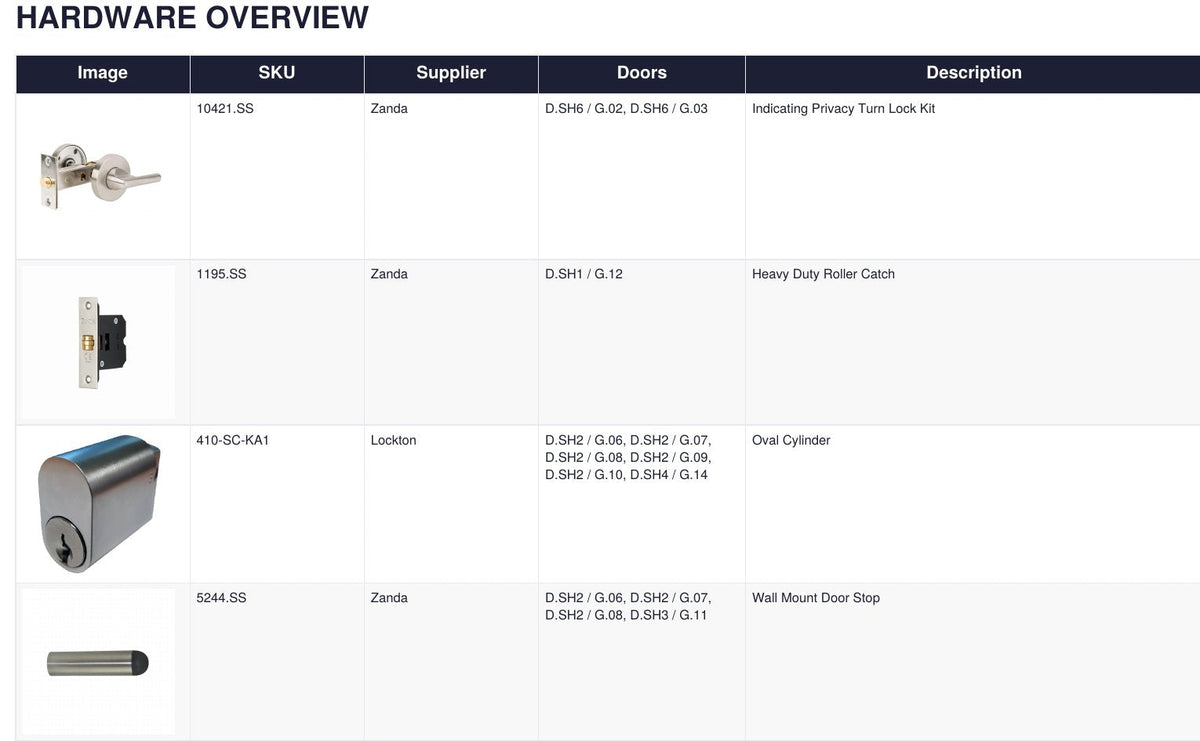
A door hardware schedule is the document that lists every piece of hardware for every door on a project: the lever or pull, lock, hinges, closer, stop, seals and keying, door by door, with the finish and quantity for each. It is what the estimator prices from, what the supplier orders from and what site checks deliveries against. Get it right and the hardware arrives ready to fit. Get it wrong and the gaps show up at handover.
This guide covers what a hardware schedule includes, who prepares it, when it should be done, what it is checked against in Australia and the mistakes it prevents. It is written from the schedules our Commercial Projects Division prepares every week for builders, architects and developers across Western Australia.
What is a door hardware schedule?
A door hardware schedule, sometimes called a hardware schedule or ironmongery schedule, is a door by door specification of the hardware on a project. Each door, or opening, is listed with its number from the drawings, its location and everything that goes on it.
It sits alongside the door schedule, which describes the door leaf and frame itself: size, material, fire rating and finish. The door schedule says what the door is. The hardware schedule says what goes on it.
In short: one line per door, every item listed, nothing assumed.
What does a door hardware schedule include?
For each opening, a complete schedule shows:
- Door number and location, matched to the architectural drawings.
- Function: passage, privacy, entrance, storeroom, or a commercial lock function such as classroom or office.
- Lever, knob or pull handle, with the brand, product code and finish.
- Lock or latch, with the backset, so it matches the door preparation.
- Cylinder and keying: keyed alike, keyed to differ or master keyed.
- Hinges, sized to the door weight and type, with the number per leaf.
- Door closer, with the arm type and the side it mounts on.
- Door stop or holder, wall or floor mounted.
- Seals: perimeter, acoustic, smoke and weather seals, plus automatic drop seals where needed.
- Bolts for the inactive leaf of a pair of doors.
- Protection: kick plates and door edge protection.
- Handing, so each item goes on the correct side.
A good schedule then rolls everything up into a hardware overview: one list of every product on the job, with a photo, code, supplier and the doors it goes on. That overview is the page you price from.

Who prepares the door hardware schedule?
It depends on the project. On larger commercial jobs, the architect often specifies the hardware intent and a hardware supplier or manufacturer prepares the detailed schedule. On residential and smaller commercial jobs, it often falls to the builder, the designer or nobody at all, which is where most problems start.
Many hardware suppliers will prepare a schedule, but a manufacturer schedule usually covers only that manufacturer's products. Everything else is marked by others, and those items are the ones that go missing.
An independent hardware specialist can schedule across brands, so each door gets the right product rather than the nearest one in a single catalogue.
When should the hardware schedule be done?
Before the doors are ordered. The hardware decides how the door is prepared: the lock pocket, the backset, the hinge positions, the closer fixing and any reinforcing. If the schedule comes after the doors are made, you are fitting hardware to holes rather than holes to hardware.
As a rule, start the hardware schedule when the door schedule is drafted and finalise it before door manufacture. Allow lead time for imported product and for keying.
What standards is a door hardware schedule checked against in Australia?
Every opening should be checked against the project specification and the codes that drive hardware selection, including:
- The National Construction Code (NCC), for egress, fire safety and access requirements.
- AS 1905.1, for fire resistant doorsets. Fire doors need hardware that suits the tested doorset, so hinges, locks, closers and seals are not a free choice.
- AS 1428.1, for access and mobility. This affects lever design, operating force, heights and privacy indicators on accessible doors.
The building surveyor, fire engineer and access consultant remain the final authority. A good schedule works to their reports and flags anything that needs their sign off.
What goes wrong without a proper schedule?
Most hardware problems are cheap on paper and expensive on site. These are the ones we see most:
- The wrong function on the wrong door. A privacy set where an entrance set was needed, or a passage set on a powder room.
- Under rated hinges. Standard hinges on a solid core or fire door sag and damage the frame.
- Mismatched backsets. The lock, lever and door preparation do not agree, so nothing fits.
- Missing small items. Stops, flush bolts, roller catches and seals that nobody listed.
- Items marked by others. Lines on a supplier schedule that nobody owns, so nobody orders them.
- A finish discontinued mid build. Half the house in one finish and the rest in something close.
Can you review a supplier schedule we already have?
Yes. If an ASSA ABLOY, Allegion or dormakaba schedule already exists, it is worth having it reviewed before pricing. We check it door by door and flag every item marked by others, every TBC and anything missing, so you know exactly what the schedule does and does not cover.
How much does a door hardware schedule cost?
At Entry Point, nothing. We prepare the schedule at no charge and quote supply off the finished schedule. You receive a PDF to issue and a live link where you and your client can comment door by door, and we reissue until it is signed off.
What do I need to send to get a hardware schedule?
- Floor plans or a door schedule, in any format.
- Your preferred finish or scheme.
- Any brands already specified.
- Your programme, so lead times can be planned.
Only have half of that? Send it anyway and we will tell you what is missing. We come back within one business day and aim to have the first draft schedule back inside a week.
From schedule to site
Once the schedule is approved, every item is packed in our Palmyra warehouse and labelled to its door number, then delivered in stages to suit your programme. At handover you receive a warranty register covering every supplier on the job.
Explore further
- Commercial Projects Division: how we run a project
- Download our commercial capability statement (PDF)
- Door function guide: passage, privacy or entrance
- Shop commercial door hardware
Have a project coming up? Email your plans to sales@entry-point.com.au or call 1300 522 163.